Showing posts with label History. Show all posts

Has the Mystery of Amelia Earhart's Disappearance Been Solved?

Posted by Unknown on Thursday, October 30, 2014

The disappearance of Amelia Earhart somewhere over the Pacific Ocean back in 1937 created one of the most compelling and enduring mysteries of the 20th century. The pioneering aviator, along with her navigator Fred Noonan, were attempting to fly around the world at the equator when they vanished while searching for a fuel stop on Howland Island. What became of them has been open to speculation for more than 77 years. Now, with the help of a piece of scrap metal, researchers believe they have solved that mystery at last.

Yesterday, The International Group of Historic Aircraft Recovery (TIGHAR) reported that they had successfully linked a piece of scrap metal discovered on the island of Nikumaroro with Earhart's plane. The piece of metal in question is 19 inches wide (48.2 cm) and 23 inches (58.4 cm) long, and was installed on her aircraft on a layover in Miami. It was part of a modification to the Lockheed Electra aircraft that would have allowed the pilot to be able to look out her window more easily so that she could navigate by the stars at night.

According to the TIGHAR report, the piece of metal was originally found on Nikumaroro, an island in the Republic of Kiribati, back in 1991. Researchers claim that by studying the part, they have determined that it not only matches the size and shape of the one added to Earhart's plane, but it made up of the same type of metal, fits consistently with shape of the Electra, and has the same unique rivet pattern as the infield modification. Those variables virtually ensure that it is a part from the missing aircraft.


Historians know that Earhart and Noonan were running low on fuel when they were approaching Howland Island. Somehow, they got off course and could not find the airstrip, but instead were forced to put down on Nikumaroro, which is about 350 miles from their intended destination. It is widely believed that they not only survived the landing, but existed on the island for a time, most likely eventually dying from dehydration. Nikumaroro has very little fresh water, and is said to be a harsh environment with extreme heat, little shelter, and not much to eat.

Examinations of radio records also show that Earhart most likely used the radio on her Electra to try to call for help, but the signals were ignored or not properly heard at all. The aircraft was most likely pulled out to sea by rising tides, which not only hid it from future search teams, but also removed the only resource that Earhart and Noonan would have had at their disposal. TIGHAR researchers believe that the plane is still there, on the west end of the island somewhere.

A few years after she crashed, a British colony was established on Nikumaroro, and existed there into the 1960's before it was abandoned due to a lack of resources. During that time, colonists discovered human bones on the island, which some now believe may have belong to Earhart or Noonan. The box of a sextant was also found there, and it was consistent with one that Noonan would have used for navigating as well. Over the years, these clues have disappeared however, so it is unlikely that they can be used to further establish a link to the final resting place of the aviator and her navigator.

TIGHAR researchers are hoping to return to Nikumaroro in the future, and search for more clues to the mystery. The group is currently seeking funding to mount another expedition, even though they have visited the island on multiple occasions in the past. Until they discover the Electra itself, there will likely always be some speculation as to the ultimate fate of Earhart. But this latest clue seems to give us the most likely ending to her historic flight.


More aboutHas the Mystery of Amelia Earhart's Disappearance Been Solved?

Notebook From Ill-Fated Antarctic Expedition Discovered in Ice

Posted by Unknown on Friday, October 24, 2014

A notebook belonging to a photographer on the 1911-1912 Terra Nova Expedition to the Antarctic – famously led by British explorer Robert Falcon Scott – has been discovered frozen in the ice. The century-old book offers a glimpse of what conditions on that expedition were like, as Scott and his team attempted to become the first men to reach the South Pole.

The notebook belonged to a British scientist named George Murray Levick, who was a part of the Northern Party on the Scott expedition. The hand written notes are said to still be legible, although the binding has been worn away after being exposed for more than a hundred years to the elements. It was discovered outside of a cabin that served as Scott's last base before setting off to the Pole. Last year's ice melt exposed the book for the first time.

A team of forensic scientists painstakingly restored and preserved the pages, which contain details of the photos that Levick took while part of the expedition. The notes offer hints on the subjects, dates, and exposure details for the images that he shot. Levick himself was not a part of Scott's South Pole team, but he and others faced challenges of their own, spending the winter in ice cave while they waited to depart the harsh Antarctic climate.


The tale of Scott himself is well known at this point. After several failed attempts, he found himself in a race to become the first man to reach the South Pole with Norwegian Roald Amundsen. Both men actually achieved their goal, but Scott arrived just a few weeks behind his rival, missing the glory of being first by a narrow margin. On the return trip to the coast, Scott and his men faced numerous hardships before being caught in a massive blizzard. Tent bound, they ended up freezing to death, as they waited out a storm that lasted ten days. They perished just a few miles from a supply cache that would have saved their lives.

While this newly discovered notebook doesn't offer much insight into what Scott and his men faced on their final, dreadful, march, it does offer some insights to the expedition as a whole. Levick's team stayed along the coast, exploring a section of the Antarctic that remained unknown at the time. When winter pack ice made it impossible for the team's ship to retrieve them from the ice, they were forced to spend the winter in an ice cave that they dug themselves. They also ate seals and penguins in order to survive.

After restoring the notebook, the team of New Zealand researchers who found it have now returned it to Scott's cabin at his base camp on Cape Evans. Over the past few years, the same group has been meticulously restoring other artifacts from the expedition, and creating a make-shift museum of sorts in the Antarctic.
More aboutNotebook From Ill-Fated Antarctic Expedition Discovered in Ice

Archeologists Uncover "Huge" Structure in Israel that Predates the Pyramids

Posted by Unknown on Friday, September 19, 2014

Archaeology fascinates me. I love the fact that we're still uncovering hidden things from our past, and learning about early civilizations. That's why this story caught my attention when I came across it yesterday. It seems that archaeologists working in Israel have unearthed a massive structure near the Sea of Galilee that is is believed to have been built sometime between 3050 BC and 2650 BC. That would make it older than the Great Pyramids in Egypt, and even Stonehenge in the U.K.

 The structure was previously mistaken for a defensive wall of some sort, although no settlement was known to have existed in that part of the country. It is immense in size, stretching for 150 metes (492 ft), and has a volume that is said to be roughly 14,000 cubic meters (500,000 cubic ft). It is believed to have been a standing monument of some type, although what it was used for remains a bit of a mystery. Researchers speculate that it was used as a landmark built to "mark possession or assert authority."

The crescent shaped structure may have been built by a local chieftain in the Mesopotamian civilization. Its shape could have held some significance within the lunar cycle, or  it could have also been a monument built to Sin, the culture's moon god. The closest settlement is a town called Bet Yerah, which translates to "House of the Moon God." It is just 29km (18 miles) away, which is about a days walk for ancient travelers. There is some speculation that the monument was built to mark the borders of the city's territory, and to potentially ward off would-be invaders.

The age of the structure was determined by dating fragments of pottery that were found at the site. The monument is so old, that it actually predates the Old Testament, and provides clues about life in the region that is often referred to as the "Cradle of Civilization." Researchers say the site would have required a massive amount of labor to build. They estimate that it would have taken between 35,000 and 50,000 days working days to construct the monument, which translates to a team of 200 people working for roughly five months straight just to achieve the lower end of that estimate. In an agrarian society dependent on food production, that would have been incredibly tough.

Reading a story like this one, it makes you wonder what else is out there, just waiting for us to stumble across it.
More aboutArcheologists Uncover "Huge" Structure in Israel that Predates the Pyramids

Ship Missing for 160 Years Found in the Arctic

Posted by Unknown on Wednesday, September 10, 2014

Back in 1845, famed British explorer Sir John Franklin set out to find, and navigate, the Northwest Passage. With him he took two ships, and 129 men, with the hopes of discovering a way to sail across the Arctic from the Atlantic Ocean to the Pacific Ocean. Not long into the expedition, Franklin, his men, and the ships disappeared, creating one of the great mysteries of that era. Now, one of the ships has been found, shedding some light on what became of the crew.

Today, the Northwest Passage is a very real navigational route that opens for a few months each summer. Climate change has warmed the Arctic enough that the ice that once kept the Passage permanently sealed now gives way for ships to pass through. In Franklin's day however, the route was mostly a myth that a few explorers raced to discover. Sailing the Arctic Ocean in that era was a treacherous affair, fraught with uncertainty.

Franklin's ships were named the HMS Erebus and HMS Terror. Exactly which ship has been located is unclear, but a team of explorers using sonar have found, and positively identified, one of the vessels at the bottom of the Victoria Strait. They believe that locating the first ship will provide some clues as to where the second can be found as well.


When Franklin and his ships went missing, a major search operation was launched by the British Navy. From 1848 to 1859, numerous expeditions ventured into the Arctic with the hope of locating the explorer and his men. When the hope that they could still be alive faded, the search continued to discover the fate of the crew instead. Unfortunately, no trace was found, and what happened to them remained a mystery. Over the years, there have been more than 50 attempts to find Franklin's ships, but little progress was ever made. In the 1980's, three bodies that were believed to be a part of the crew were discovered, and they contained high levels of lead in their system. That led to the theory that the sailors were poisoned by lead from the cans that contained their food. The Canadian government launched its own search back in 2008, and this latest expedition was an extension of those efforts. They were finally successful just a few weeks back.

Finding the ship sheds a bit of light on what happened, but it doesn't tell the entire tail. It is believed that the two vessels became trapped in the ice, and were slowly crushed under the weight. The crew more than likely had time to abandon ship, and escape onto the ice, where they no doubt faced a difficult challenge for survival. The local Inuit tribes, which had referenced the location of the ship for years, say that the men resorted to cannibalism in an attempt to survive. Eventually, they would all succumb to cold and starvation.

Locating the ship brings a bit of closure to one of exploration's great mysteries. We will probably never know the full tale, but at least there are some indications of what happened to the crew.
More aboutShip Missing for 160 Years Found in the Arctic

Shackleton 100 Celebrates The Greatest Survival Story of All Time

Posted by Unknown on Thursday, August 21, 2014

100 hundred years ago this month, Ernest Shackleton and his crew of 27 men, set out from Plymouth in the U.K. aboard their ship, the Endurance. Their destination was Antarctica, where Shackleton and his team hoped to become the first men to make a land crossing of the frozen continent. But fate had other plans for the veteran polar explorer and his men. That crossing would never take place, and they would soon find themselves in a fight for survival that seems hard to believe, even a century after it took place.

To celebrate the 100th anniversary of the Endurance Expedition, an organization called Shackleton 100 is organizing a series of events that will commemorate the historic journey. Over the next two years, the group will recognize some of the major milestones that occurred on the expedition. The first of those events was a re-enactment of the launch of the Endurance a century earlier.

It would take weeks for the Endurance to reach the Southern Ocean, with the ship and her crew reaching South Georgia Island, where they resupplied and sent back word of their progress, before proceeding onward. They left the island on December 5, 1914, and approached the Antarctic continent soon there after. Heavy ice slowed progress for a time, but they pressed forward. Shackleton was eager to begin the traverse, as it was summer in the Southern Hemisphere. But on January 19, 1915, the ship became stuck in the ice, completely surrounded, and unable to move in any direction. Disaster had struck.

Shackleton and his crew stayed aboard the Endurance, for a few weeks before he realized that the only way the ship would break free would be to wait for the spring thaw. That was still months away, so in February, the crew disembarked from the ship, and set up a temporary base on the ice flows. There they stayed through the long Antarctic winter, waiting for someone to come rescue them, or for their own ship to break free from the ice at last.

It would be September before the thaw would begin, but the pressure that the shifting ice placed on the Endurance was too much. On October 24, her hull was breached, and it soon became clear that the ship was lost. All of the supplies for the expedition were offloaded onto the ice, and on November 21, the vessel sunk beneath the surface. The men truly were stranded, hundreds of miles from the closest human settlement.


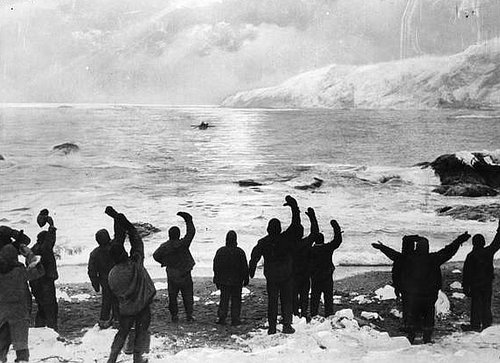
The crew of the Endurance stayed on the ice for nearly two months, hoping that it would flow close enough to Paulet Island that they could retrieve a supply cache that they had left there. But the Southern Ocean wasn't cooperating, and thick ice continued to block their way. Forced to move their base of operations to another ice flow, and set up a camp called "Patience," the men continued to wait, but in April of 1916 that ice flow began to break apart, and Shackleton ordered his men into lifeboats. They survived five long, and very difficult, days at sea, crossing nearly 350 miles (560 km) of open ocean, before landing on the remote Elephant Island, exhausted and without hope.

Knowing that their supplies were running low, and that Elephant Island was far from the shipping lanes, Shackleton made a bold move to try to find help. Taking just five men, he took one of the lifeboats, and set off on an open-water crossing of the Southern Ocean in an attempt to reach South Georgia, where a whaling station was maintained year round. It took 15 days to cover the 800 nautical miles (1480 km) to reach the island, and when they did, the men were on the wrong side. Rather than risk returning to the sea, Shackleton, along with two of his men, force marched for 36 hours, covering 32 miles over very rough terrain to reach the whaling station, and the help they were desperately searching for. That was on May 20, 1916.

Fearing for the safety of his men still on Elephant Island, Shackleton immediately went to work organizing a rescue. But, just like everything else on this expedition, it didn't go as planned. Heavy ice blocked the approach to the island, and it took three tries before a ship was able to locate the crew of the Endurance. They were rescued on August 30, more than two years after they had set sail from Plymouth.

Through this entire ordeal, Shackleton remained steadfast in his leadership, and always looked out for the safety of his men. After all they had been through – the loss of they their, ship, living for months on the ice, the long ocean crossings, the lack of supplies, etc. – not a single member of the crew was lost. That is a fact that continues to amaze me to this day.

Shackleton and his men returned to a world that they could barely recognize. When they had set out on their expedition in August of 1914, a war was on the verge of breaking out in Europe. The predominant feeling at the time was that it wouldn't last long, and that life would return to normal in a matter of months. That conflict escalated into the first World War, and in 1916 a stalemate of sorts was underway. By that point, millions of lives and been lost, as new weapons of mass destruction, including poison gas, flame throwers, and machine guns, were introduced on the battlefield for the first time. Europe was in chaos, and madness had gripped a world of sanity that Shackleton and his crew had left behind.

Many of the men would recover from their ordeal, only to be pressed into service in the war. Some of them would not survive. Shackleton himself volunteered for duty, and requested an assignment in France. He was denied that request, and was instead sent to South America in an attempt to rally other countries to help fight the war. It was a job he was ill suited for.

After the war, he went on the lecture circuit, and later organized one last expedition to the Antarctic. During that final voyage, Shackleton suffered a fatal heart attack and died. He is buried on South Georgia Island today.

The Shackleton 100 group plans to commemorate all of these milestones, and more, in the weeks and months ahead. You can find a full calendar of events on the organization's website, with a schedule that runs through October of 2016.

As I've said before, Shackleton's story is perhaps the greatest survival story of all time, and I definitely feel it is one that should be retold for a generation that probably knows little about this famously doomed expedition. Hopefully, the efforts of the Shackleton 100 will help share that story.
More aboutShackleton 100 Celebrates The Greatest Survival Story of All Time